
MS Academy

Vocational Training Programme in Music & Media

A hands-on training programme for persons with disabilities aged 16 and above — learn real skills in music, sound and media, and take your first steps towards a job you enjoy.

← Part of Project InteGr8

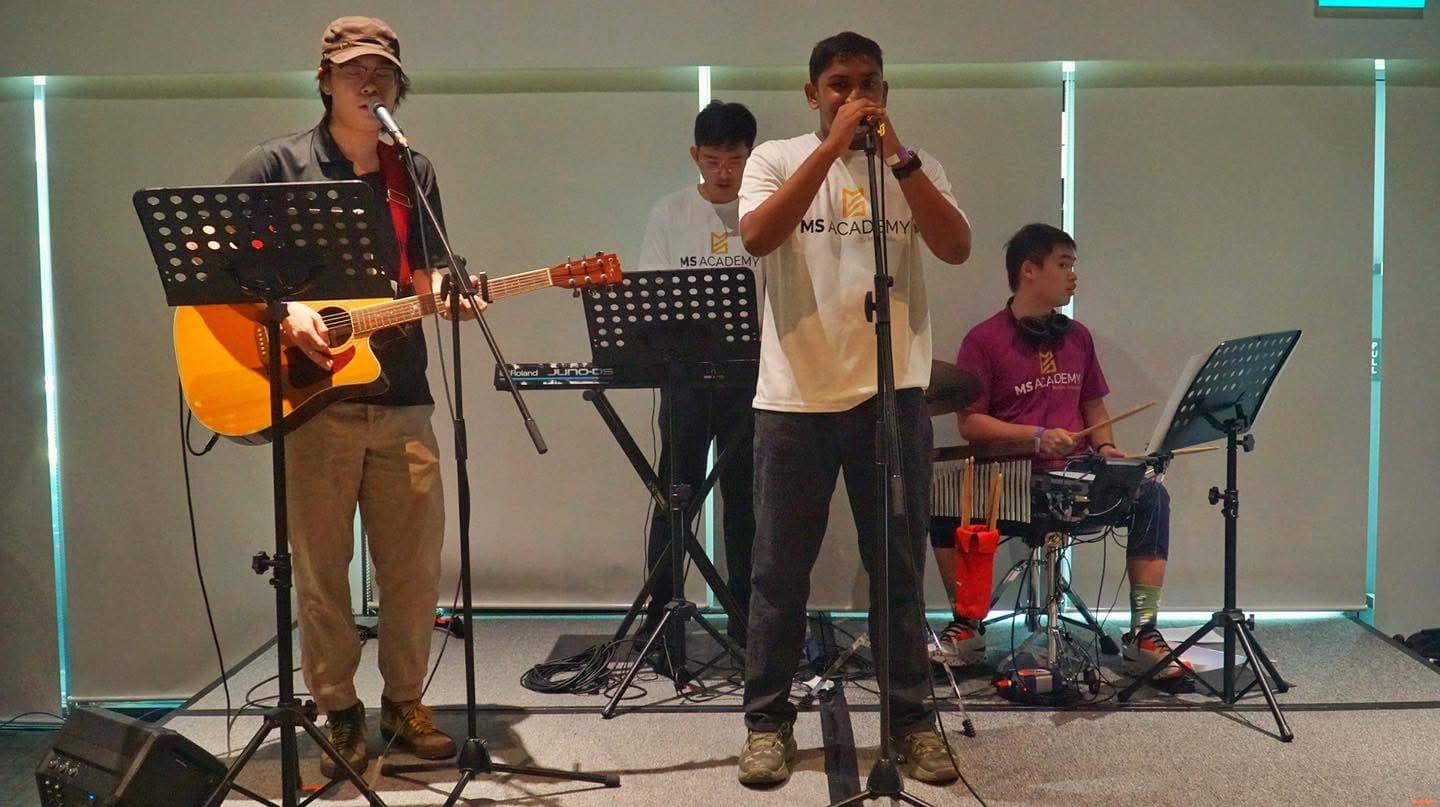
A group of learners playing guitars, keyboard and drums together in a band rehearsal

About the programme

Learn by doing, at your own pace

Run by MS Academy as part of Project InteGr8, this programme prepares learners for work in the music and media industries. Each learner chooses one of two pathways, then works through a set of practical modules where they learn by doing — caring for instruments, setting up sound for a show, producing a song on a laptop, or playing in a band.

Every module runs over two levels. Learners complete Level 1 and Level 2 of each module in their pathway — including the performance modules — to finish the programme.

Modules are taught in small groups, patiently and paced to each learner. Alongside practical skills, every learner builds the everyday work habits that employers value: turning up ready, following instructions, looking after equipment and working well with others.

Every pathway includes performance training, so whichever route you choose, you will learn to play music with others and gain the confidence to perform.

Who is this programme for?

This programme is for persons with disabilities aged 16 and above who want to learn practical skills and find a pathway into work. You do not need any music experience to apply — just an interest in music or media and a willingness to learn.

Applicants with intellectual disabilities and applicants on the autism spectrum are especially encouraged to apply.

  • 16 years old and above
  • Singapore Citizen or Permanent Resident
  • Proof of disability

Pathway 01

Technical + Performance

Technical Track

In the Technical Track, learners get to know instruments from the inside — how they are built, how to keep them in good condition and how to fix everyday problems safely. Modules are taught in a workshop-style setting with real instruments and tools, and each one runs over Level 1 and Level 2.

To complete this pathway, learners finish Level 1 and Level 2 of every module below, plus the Performance Track modules.

Strings Technical

About the moduleLevel 1 & 2

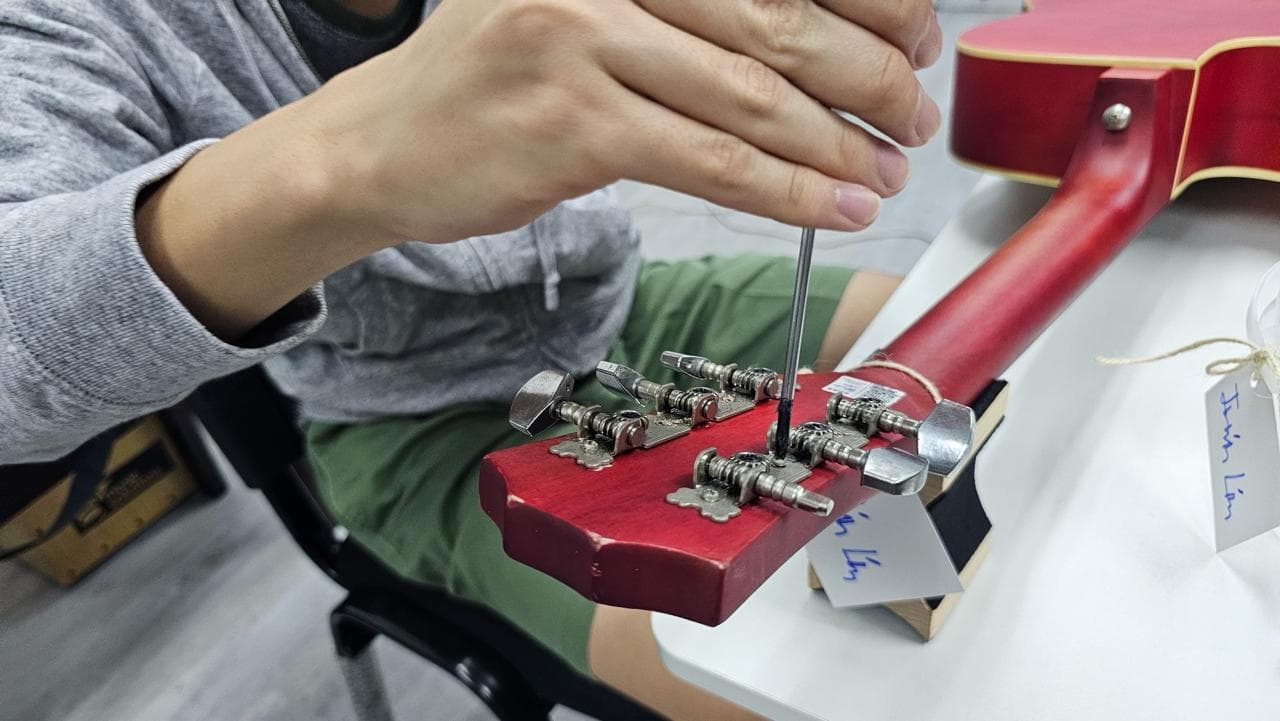
Learn how guitars, ukuleles and violins are put together and how to keep them in great condition. You will change strings, clean and tune instruments, and use servicing tools safely — with a strong focus on care, accuracy and doing things the professional way.

Knowledge
  • The main parts of guitars, ukuleles and violins, and what each part does
  • Common problems these instruments have and how to look after them
  • How to stay safe and use servicing tools properly
  • The step-by-step routines used for cleaning, maintenance and simple repairs
Skills
  • Change strings with steady hands and careful finger control
  • Choose and apply the right cleaning products
  • Use basic tools such as string winders and violin wrenches safely and correctly
  • Follow servicing checklists and step-by-step instructions
Attitudes
  • Care and responsibility when handling instruments
  • Patience, focus and attention to detail
  • Willingness to learn, ask for help and work with others
  • Pride in a job well done and confidence in completing practical tasks
Drum Technical

About the moduleLevel 1 & 2

Learn to care for both acoustic and electronic drum kits. You will get to know each part of the kit, set kits up and pack them down, tune and replace drum heads, keep everything clean, and sort out common problems. For electronic kits, you will also learn basic setup and cable connections.

Knowledge
  • The main parts of acoustic and electronic drum kits and what they do
  • How to tune, maintain and care for drums
  • The differences between acoustic and electronic drum systems
  • How to stay safe around drums, hardware and electronic components
  • Common issues that come up with drum equipment
Skills
  • Assemble and take apart drum kits safely for transport
  • Carry out basic maintenance such as changing heads, tuning and cleaning
  • Connect and manage cables and modules on electronic kits
  • Spot and report common equipment problems
Attitudes
  • Safety first when handling drum equipment
  • Patience, focus and precision during servicing tasks
  • Willingness to follow instructions and safety guidelines
  • Confidence and pride in keeping kits performance-ready
  • Taking responsibility for finishing a task

Piano Technical

About the moduleLevel 1 & 2

Discover what goes on inside an upright piano and how to keep it in good shape. You will learn to clean the cabinet and keys safely, check that keys and pedals are stable, understand how tuning works, and carefully remove and refit panels — building the care and precision that piano work demands.

Knowledge
  • The parts of an upright piano — cabinet, keyboard, pedals, strings, hammers and dampers
  • How piano tuning works, the tools involved and good practice
  • How humidity and temperature affect a piano
  • How to check that the piano's moving parts are working properly
Skills
  • Clean the cabinet, the inside of the piano and the keys safely
  • Support a professional piano tuner during tuning
  • Check that keys and pedals are stable and working
  • Tune a single piano key (all three strings)
  • Safely remove and refit the fallboard, key slip and cabinet panels
Attitudes
  • Care for delicate piano components
  • Precision and awareness of the piano's environment
  • Willingness to support specialist technicians
  • Responsibility for the instrument's condition and tuning

Live Sound Management

About the moduleLevel 1 & 2

Learn how sound is set up and run for live performances and events. You will handle microphones, mixers, speakers and cables, understand how sound travels through the system, try basic mixing, and practise safe cable management — with real or simulated shows to work on as part of a small crew.

Knowledge
  • The basics of live sound and how an audio signal travels from microphone to speaker
  • What common live sound equipment does — microphones, mixers, speakers and cables
  • How to manage power safely
  • The basics of EQ and compression
  • Safety practices and responsibilities at a live event
Skills
  • Set up and pack down basic live sound equipment safely
  • Connect and manage microphones, cables and speakers correctly
  • Operate basic mixer controls with guidance
  • Support live performances and events as part of a small technical team
Attitudes
  • Responsibility and care when handling sound equipment
  • Focus, alertness and calm during live events
  • Willingness to follow instructions and work as a team
  • Confidence and pride in helping a show run smoothly

Also included

Performance Track

Performance modules in Piano Performance, Drums Performance, Strings Performance are part of this pathway — Level 1 and Level 2 of each.

See the Performance modules

Pathway 02

Creative + Performance

Creative Track

In the Creative Track, learners find their own musical voice. Each module runs over Level 1 and Level 2, moving from ideas to finished work — a song, a track, a video — with plenty of room to experiment, get feedback and try again.

To complete this pathway, learners finish Level 1 and Level 2 of every module below, plus the Performance Track modules.

Digital Creation in DAW

About the moduleLevel 1 & 2

Make music on a computer. Using digital audio workstations (DAWs) such as GarageBand, Ableton and BandLab, you will build original tracks and remixes from MIDI, loops and plugins, layer sounds together and add effects to shape the mood of a song.

Knowledge
  • The essential features of DAWs such as GarageBand, Ableton and BandLab
  • What MIDI is and how it is used
  • How loops, plugins and virtual instruments work
  • How to layer instruments and tracks
  • How the elements of a track shape its mood and feel
  • What different DAWs are best used for
Skills
  • Start a new DAW project to create a song
  • Add MIDI instruments and other plugins
  • Layer three to six tracks into an original song
  • Use built-in effects to lift a song
  • Remix an existing track into something new
Attitudes
  • Attention to detail with equipment and software settings
  • A good ear for balance when mixing several tracks
  • Creativity and a willingness to experiment
  • Curiosity when exploring new sounds and effects

Music Video Production

About the moduleLevel 1 & 2

Plan, shoot and edit a music video from start to finish. You will come up with a creative concept, draw a storyboard, plan the shoot day, handle cameras and lighting safely, and edit the footage into a finished video.

Knowledge
  • How a music video is made, from idea to finished video
  • How to turn an idea into a storyboard
  • The different kinds of footage, such as A-roll and B-roll
  • How video editing software is organised
  • How to plan the logistics of a shoot
Skills
  • Come up with a creative concept
  • Turn a concept into a storyboard
  • Use cameras safely and efficiently
  • Edit footage using video editing software
  • Plan a shoot day, including the practical details
  • Choose and use the right lighting for the shot
Attitudes
  • Creativity in developing ideas and concepts
  • Planning ahead and picturing how a shoot might go
  • Adapting when things change on the day
  • Willingness to pick up new skills

Songwriting Fundamentals

About the moduleLevel 1 & 2

Learn to write lyrics that say something. You will explore rhyme, song structure and rhythmic flow, study how your favourite songs are built, and write your own lyrics to match the mood of a backing track.

Knowledge
  • The building blocks of lyrics — rhyme, structure, alliteration and more
  • How lyrics flow with the rhythm of a song
  • How to find and hold on to the central idea of a song
  • How word choices change with the message of a song
Skills
  • Build rhymes from existing song lines
  • Develop lyric ideas using literary devices
  • Pick out the lyrical elements in existing songs
  • Write lyrics that match the emotional mood of a backing track
Attitudes
  • Perseverance when a concept is difficult
  • Attention to detail when analysing lyrics
  • Creativity in adapting an idea into something new

Music Composition

About the moduleLevel 1 & 2

Create your own music. You will explore rhythm, harmony, chord progressions and song structure, turn lyrics into melodies and song frameworks, and use dynamics and tempo to give your music real feeling.

Knowledge
  • Rhythmic and ensemble elements such as ostinato, bass line and timbre
  • Basic chord progressions in common major and minor keys
  • The song structures used in pop music
  • The musical elements that shape mood
Skills
  • Sketch a song structure from a set of lyrics
  • Turn chord progressions into melodies
  • Recognise melodic and harmonic devices in popular music
  • Write intros and outros for songs
  • Use dynamics and tempo to create the mood you want
Attitudes
  • Emotional awareness and expression
  • Creativity in shaping chords into melodies
  • Striving to refine and improve your compositions
  • Willingness to learn from more experienced composers
  • Courage to try new ideas

Also included

Performance Track

Performance modules in Piano Performance, Drums Performance, Strings Performance are part of this pathway — Level 1 and Level 2 of each.

See the Performance modules

Included in both pathways

Performance Track

The Performance Track is part of both pathways, and its modules run over Level 1 and Level 2 like the rest. Every learner picks up an instrument, learns to play simple songs and rehearses with other musicians. Real performance opportunities help learners grow in confidence, teamwork and stage readiness in a supportive, inclusive setting.

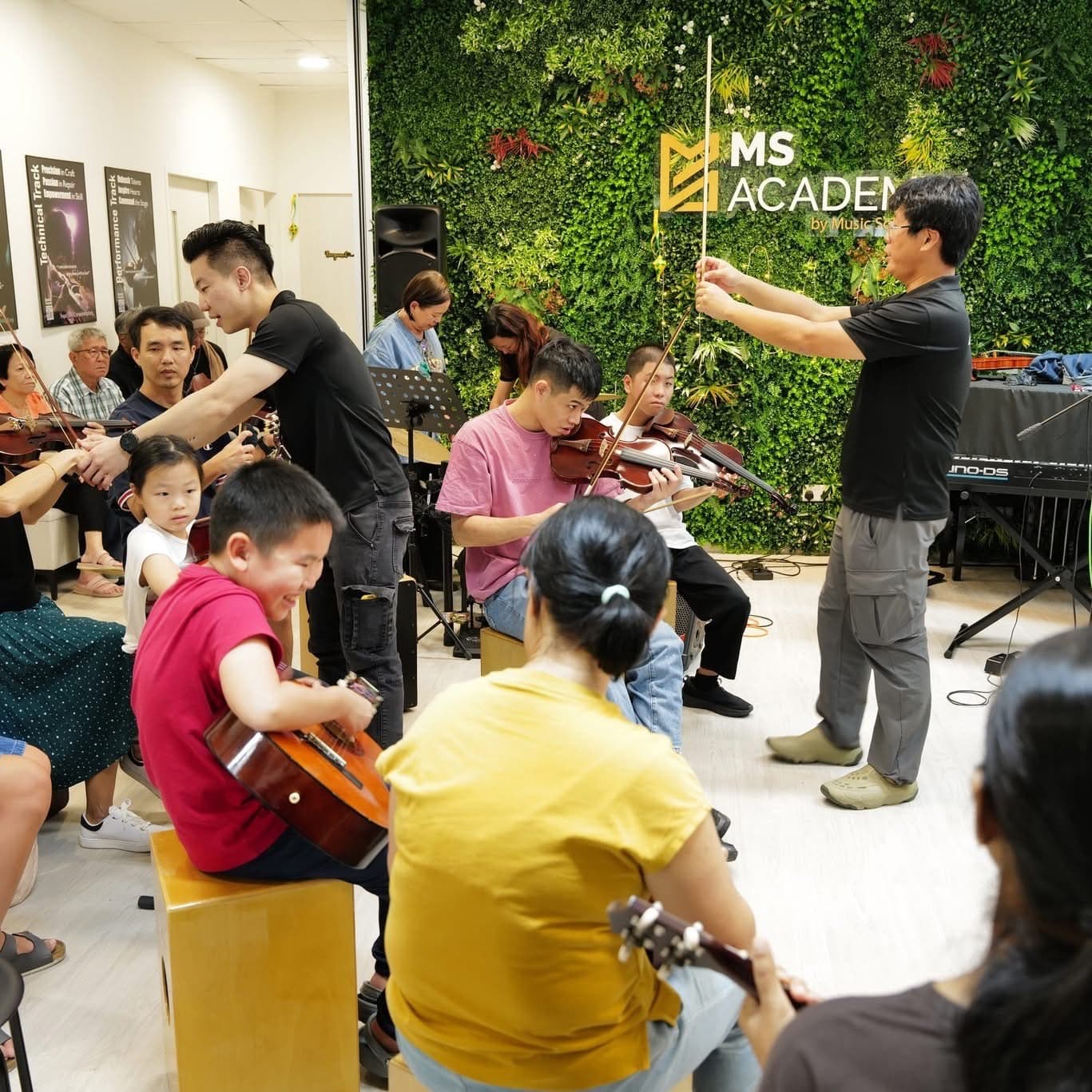
A small string ensemble of violins and cellos rehearsing together

Piano Performance

About the moduleLevel 1 & 2

Learn to play the piano step by step — starting with simple chords and accompaniment patterns, and building finger coordination, rhythm and confidence. You will practise on your own and with others, preparing to play in a band and express yourself through music.

Knowledge
  • Good posture and hand position at the keyboard
  • Common four-chord progressions
  • Accompaniment patterns such as broken chords and repeating figures
  • Ways to read music — staff notation, letter names and colour-coding
  • The piano's role in supporting harmony and rhythm in a band
  • Different keyboard settings
Skills
  • Sit or stand at the keyboard with safe posture
  • Play common chord progressions
  • Perform simple accompaniment patterns
  • Read short pieces and lead sheets
  • Provide harmonic support in a band
  • Follow cues from the band or conductor
Attitudes
  • Confidence performing with others
  • Listening actively and adapting to the group
  • Willingness to adjust to balance the ensemble
  • Taking responsibility as the band's harmonic foundation

Drums Performance

About the moduleLevel 1 & 2

Build rhythm, coordination and confidence behind a drum kit. You will learn correct setup and posture, play foundational grooves and fills, keep steady time and rehearse with small groups and inclusive bands — with real performances to work towards.

Knowledge
  • Correct kit setup, posture and stick grip
  • Basic rhythmic patterns using quarter and eighth notes
  • Beginner grooves and fills, including double snare hits, semiquavers and push notes
  • The drummer's job as the band's timekeeper
  • How songs are structured
Skills
  • Play basic grooves and patterns with steady timing
  • Keep a safe posture and setup
  • Play beginner-level grooves at a range of tempos
  • Perform double snare hits, semiquavers and push notes
  • Keep time for the band
  • Listen and respond to other musicians
Attitudes
  • Taking responsibility as the timekeeper
  • Listening and responding to the band
  • Confidence in performance
  • Willingness to adapt a groove to what the band needs

Strings Performance — Guitar / Ukulele / Violin

About the moduleLevel 1 & 2

Learn to play a string instrument through simple chords, melodies and strumming or bowing patterns. Step-by-step lessons build finger coordination, rhythm and confidence, and you will practise on your own and with others in preparation for band playing.

Knowledge
  • How to produce a clean tone on guitar and violin
  • Correct posture and how to hold the instrument
  • Basic chord progressions and simple melodies
  • Song form — verse, chorus and bridge
  • Roles in an ensemble and how players coordinate
Skills
  • Play with safe posture
  • Play basic open chords on guitar and simple finger patterns on violin
  • Perform basic strumming and bowing patterns
  • Follow chord charts, staff notation and TAB
  • Play in an ensemble, keeping time and blending with others
Attitudes
  • Confidence in musical expression
  • Willingness to collaborate in a team
  • Openness to feedback and guided improvement
  • Listening actively and adjusting to the ensemble

Assessment

How progress is assessed

There are no surprise exams. Learners are supported throughout each module and assessed in two simple ways.

01

Progressive Report

Throughout the module, trainers check in on each learner's progress. This ongoing feedback helps guide the teaching and supports each learner's individual growth.

02

Final Assessment

At the end of the module, learners show what they have learned. Trainers assess overall competency based on the learning outcomes the learner has demonstrated.

Applying

Entry requirements

The programme is open to persons with disabilities aged 16 and above who are seeking vocational skills and a pathway into employment. Applicants with intellectual disabilities and applicants on the autism spectrum are encouraged to apply.

  • 16 years old and above
  • Singapore Citizen or Permanent Resident
  • Proof of disability

Pre-assessment and admission

All applicants complete a short pre-assessment as part of admission. It helps us understand each applicant and confirm that the programme and pathway are a good fit.

Part 1 — Pathway assessment

Technical Track
Applicants complete a Purdue Pegboard Test, a simple hands-on activity that looks at fine motor skills and how well both hands work together.
Creative Track
Applicants complete a Music Functional Skills Test, which looks at self-expression, cognitive abilities, aural awareness and manipulative skills.

Part 2 — Applicant and caregiver interview

All applicants
Applicants and their caregiver attend an interview to talk through the applicant's needs and suitability for the programme. It takes around 30–45 minutes, including a consultation.

A one-time administrative fee of $150 applies, which includes the assessment. This fee is non-refundable.

Where the assessment takes place

The assessment takes place at one of the venues below. Applicants will be told the exact venue in advance.

  • Music Solutions Training Centre

    24 Sin Ming Lane, #04-106Midview City, Singapore 573970
  • Enabling Village

    20 Lengkok Bahru, The Canopy Block, #01-14/14ASingapore 159053

When you can start

Programme intakes

Each intake takes up to 8 students, so we encourage you to apply early.

Technical & Performance Track intake

  • January
  • July

Creative & Performance Track intake

  • April
  • October

Ready to take the first step?

Fill in the registration form and our team will be in touch to arrange your pre-assessment. Caregivers are welcome to complete the form on an applicant's behalf.